Dual n-back for iPhone
Practise returning to the task when your attention slips
Hold is a dual n-back game for iPhone. Each trial shows a position on a ring and plays a sound, and you tap when either matches what happened a few trials earlier.
Two trials ago
Top position. Spoken C
Now
Top position. Spoken R
Begin free · No ads · No account
iPhone, iOS 17 or later · Screens in 38 languages · Letters in 46 languages
Adaptive
Harder blocks, then back to your base.
- 2‑backBase
- 3‑backHarder block
- 2‑backBack to base
Adaptive starts at your base, your regular level. When your results support it, Hold adds harder blocks one level up, usually followed by a return to base. It gradually adjusts the amount of harder practice and explains why the next session changes.
Now and then, Hold offers an optional challenge two levels above your base. Returning to base within a session doesn’t mean your base has moved down.
How Adaptive progressesMatch a position and a sound
In 2‑back, compare each position and sound with what happened two trials earlier.
In the opening example, the top position repeats and the spoken letter changes. Tap Position and leave Sound alone.
Walk through all six trialsThe example uses English (US) sounds. In Hold, choose the language of the letters and a voice you hear clearly. The letter language can be different from the language of Hold’s screens.
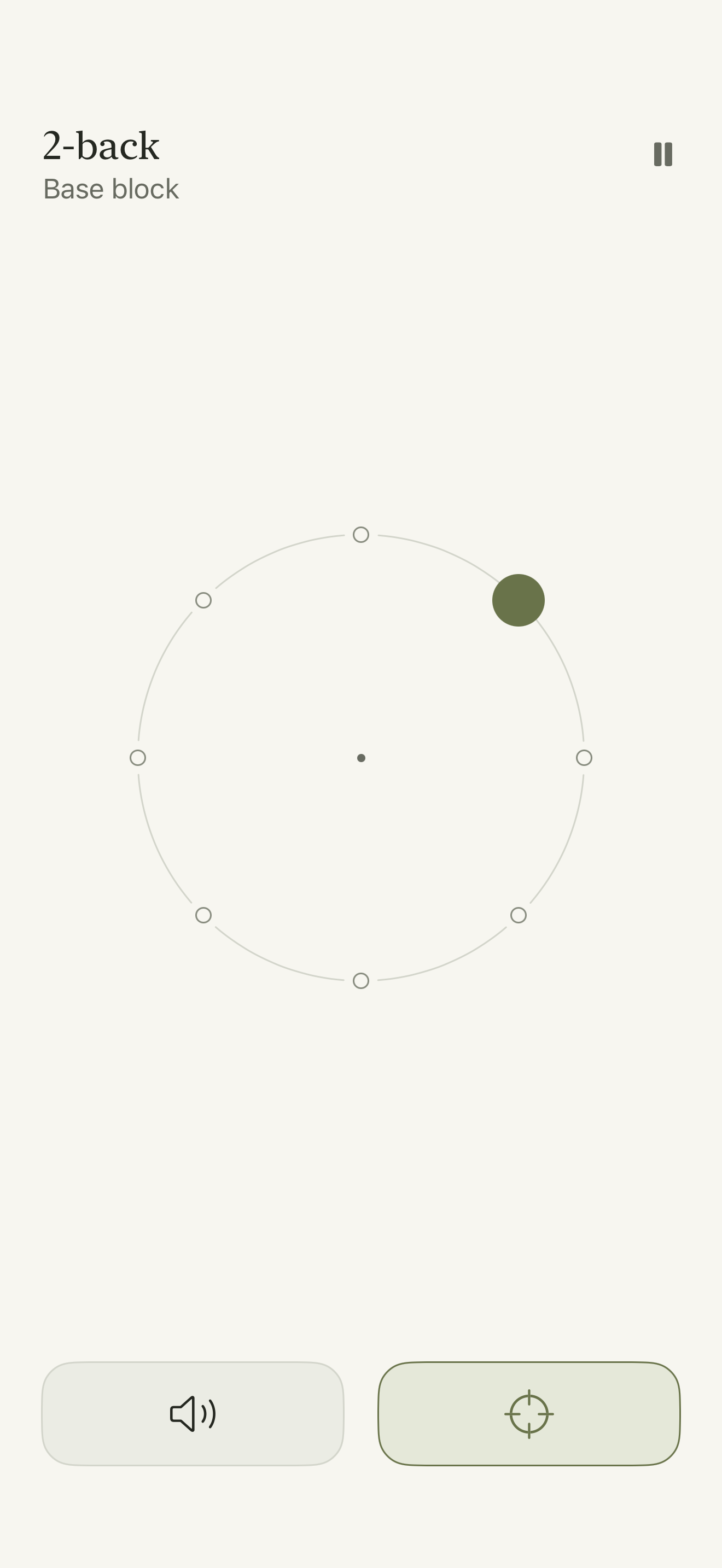
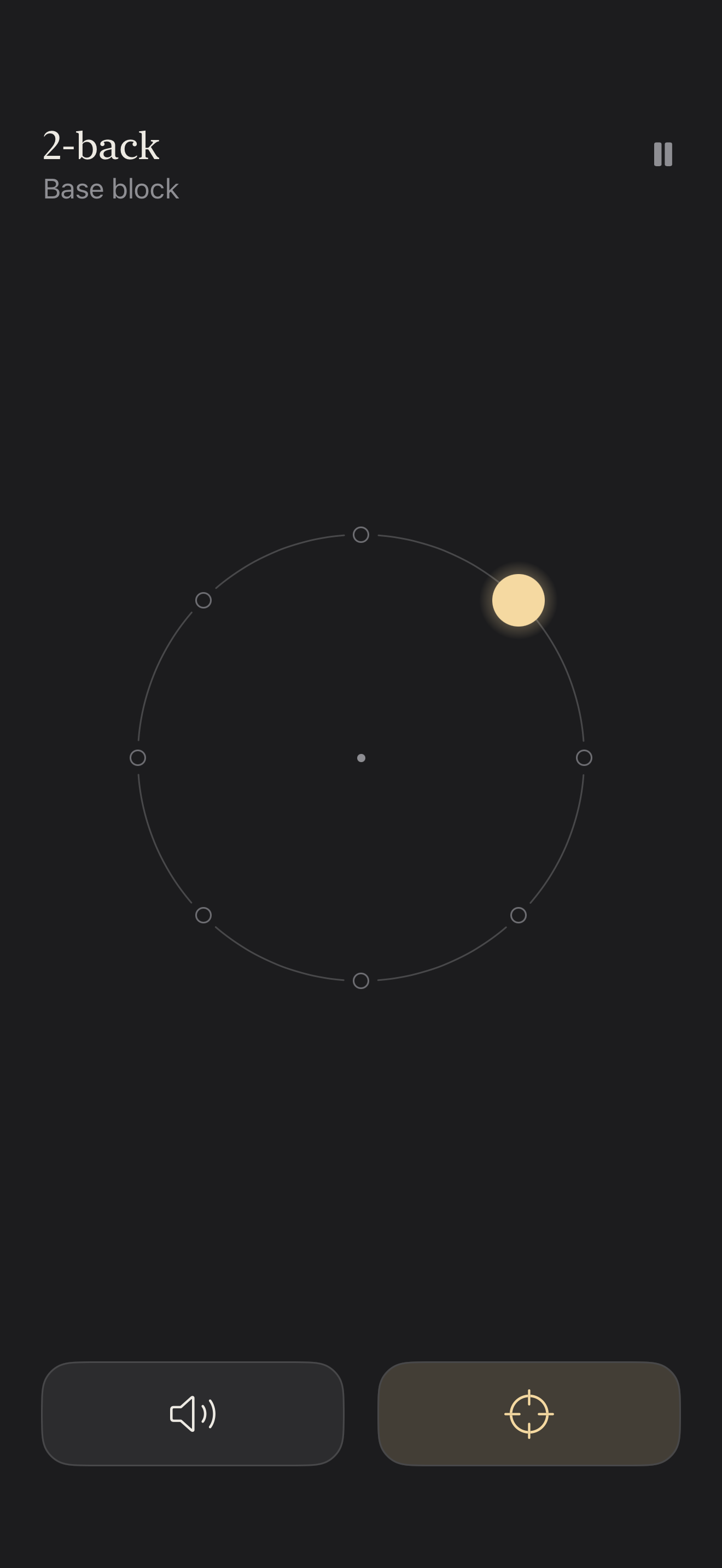
During a session
If you lose the sequence, pick up again at the next position and sound. A mistake doesn’t mean starting over. Between blocks, Hold waits until you’re ready. If you end the session early, the blocks you finished are kept.
Afterwards, you can reflect on your attention and urge to stop, or leave a note.
The guide covers losing the sequence, plateaus, practice reminders and coming back after a break. It also explains scores and what research shows.
Choose how you play
- Fixed
- Choose the level and number of blocks.
- Adaptive
- Let Hold shape the harder practice around your base.
- ∞
- Play one continuous block at your chosen level, until you end it.
- Self-paced
- Like Fixed, but each trial waits until you swipe for the next one.
Free and full version
- Begin free
Fixed, ∞ and Self-paced include 1‑back and 2‑back. Adaptive includes a 2‑back base, 3‑back harder blocks and optional 4‑back challenges when offered.
Every session is kept. For sessions from the last seven days, you can also see their scores and settings.
- Full version
- One purchase adds 3‑back to 16‑back in Fixed, ∞ and Self-paced, an Adaptive base above 2‑back, and scores and settings for every past session.
There are no ads, subscriptions or accounts. Your sessions stay on your phone, and you can export them any time.
Get Hold on the App StoreWhy I made Hold
I’ve always found dual n-back intriguing. I first tried it hoping to improve my memory. The rules are simple, but I found playing it very frustrating. If a round wasn’t perfect (or at least acceptable), I would stop halfway through and leave the game alone for a while.
In the apps I tried, the difficulty felt either too easy to hold my attention or too hard to keep going. I also didn’t want scores to interrupt me in the middle of a session.
I made Hold so that I would finish. Adaptive mixes my regular level with harder blocks, and the mixture feels almost right to me now: enough difficulty to keep me focused, without so much frustration that I give up. Scores wait until the session is over. Hearing the letters in my native language feels more natural, even with the interface in another one. It’s only a setting, but it changes the feel of the game.
Now I finish, even when it goes badly. Recently I was so caught up in something else that I could barely follow a block. I kept going over the same thought without getting anywhere. I replayed part of the block a few times, and eventually I was able to let the thought go and carry on. The session was still frustrating, but I finished it.
Sessions like that don’t worry me as much now. There’s another day to try, and I’m comparing only with myself. I left streaks out on purpose. I’d rather keep playing at the edge of what I can manage.
I no longer play in the hope of better memory. Playing has become a way to unwind and clear my mind while doing something that needs my attention. I notice when that attention slips, and I practise returning to the task.
The author
What would help you get started, or make Hold more useful to you? Email us